Showing posts with label Colliders. Show all posts

Tuesday, 15 December 2015

750 GeV Diphotons

The particle physics community is currently agog with rumours about the talks later today on LHC run 2 results.  These were planned months ago, before data taking started.  In the last couple of weeks, however, there have been steadily growing reports that both experiments see a common excess: two photons with an invariant mass of 750ish GeV.  From what I hear, CMS has about 2.8 sigma and ATLAS about 3.1.  Those are local significances, but if both experiments see an excess at the same place then we don't need to worry about that.  So, it could be very exciting.

Of course, excesses have been seen before at the LHC.  I am particularly reminded of the Higgs diphoton excess that both experiments saw, that has now pretty much gone away.  An element of caution is justified.  But that won't stop a lot of people writing papers on it.  There will be papers appearing on the arXiv tomorrow, you can be certain.  Sadly I'm not in a position to get something out that early, but I do hope to be quick enough to qualify as ambulance chasing.

Tuesday, 10 November 2015

KIAS-CFHEP Workshop Liveblog: Day Two Session One

We had a very nice reception last night, together with cheese—good cheese—which is not common here in Korea.  Today we have morning plenary talks on Cosmology, followed by the first parallel sessions after lunch.

Saturday, 31 October 2015

Next Generation Collider in China

I'm a little behind on this, but I did move in to my new apartment today.  The Guardian has reported that Chinese state media has announced that the proposed 100 TeV experiment will begin construction within 5 years.
China will begin work on the world’s largest supercollider in 2020, a mega-machine aimed at increasing understanding of the elusive Higgs boson, state-run media has reported.

Wednesday, 7 May 2014

Pheno 2014 Liveblog: Day Two Session 4

The last set of parallel talks.  I'm in B Physics 2 and BSM, for reasons that are probably apparent to anyone who knows me.

Monday, 4 March 2013

Collider Searches for Dark Matter

The quest to find non-gravitational evidence for dark matter proceeds along several different fronts.  The most direct approach is to look for dark matter particles scattering in detectors here on Earth.  Indirect searches, looking for cosmological signals of dark matter annihilation or decay, has provided a number of tantalising hints, of which the "line" signal at Fermi is the most recent.  However, directly producing dark matter at experiments like the LHC offers us the most control over the initial conditions and thus the least ambiguity in interpretation.

The problem with dark matter at collider experiments is that it is dark, i.e. it doesn't show up in the detectors.  To get around this problem we look for the production of other stuff as well as the dark matter itself.  We can then tell if the dark matter is there by seeing an apparent violation of conservation of momentum; the missing momentum is carried away by the unobserved dark matter particles.

The traditional approach to these type of searches is to take a complete model of new physics (such as supersymmetry) and use that to model the production process.  So in SUSY, we produce gluinos or squarks, which then go through a several-step decay producing dark matter and multiple Standard Model (SM) particles.  Indeed, even today the signal "jets and missing transverse momentum" is considered a characteristic SUSY search.

However, a couple of years ago an alternative and somewhat opposite approach began to become popular.

Tuesday, 13 November 2012

Depression

There's yet another new observation that agrees perfectly with the Standard Model and shows no sign of new physics.  To quote one of my friends, "this game isn't fun any more".

The process in question is the decay of a bound state of a bottom and strange quarks to two muons.  This decay is heavily suppressed in the Standard Model, happening only three times in a billion events.  The tiny Standard Model rate made it an excellent place to look for contributions from new particles and interactions.  A much higher or lower rate than expected would have been an exciting discovery.

Instead, the results agree well with the Standard Model prediction.  Technically, this is evidence rather than a true discovery (3 sigma instead of 5), but at this point it's unlikely that we'll see anything radically different.  And we have one more piece of evidence pointing towards the Standard Model and nothing else.

Tuesday, 11 September 2012

LEP 3

Way back at the beginning of August, I spotted a paper proposing a new experiment: LEP 3.  This struck me as somewhat amusing; you see, LEP—the Large Electron Positron collider—was the predecessor to the LHC.  When LEP finished its second run, it was dismantled and the LHC built in its tunnel.1  But the idea is serious, from the people at CERN no less.

To understand why, we need to consider the fundamental difference of the LHC and LEP.  As the name states, LEP collided electrons and positrons (anti-electrons).  The LHC collides protons.  There are two relevant differences: protons are much heavier, but are composite objects made up of quarks and gluons, while we believe electrons to be fundamental.  These have the consequence that the LHC (and similar proton machines) can reach higher energies, but with less precision.

Tuesday, 3 July 2012

The Tevatron Higgs Announcement

The Tevatron today announced stronger evidence for the Higgs from its own searches.  There had been rumours that such an announcement would be made before the LHC likely claims discovery on Wednesday.

The Tevatron results are not enough, by the standards of the particle physics community, to claim discovery.  They are not even enough to claim "evidence", a lower standard where people tend to start getting excited.  But the results are very interesting and useful, even so.  A big part of this is because the Tevatron search channels are different to the ones currently used by the LHC.

Tuesday, 26 June 2012

The Good and Bad Side of Finding the Higgs

In a previous post, I commented
Of course, in some respects it would be more interesting if those hints are wrong and there is no Standard Model Higgs ...
I thought I'd expand on this a bit.  You see, the LHC is a multi-billion dollar, multi-national enterprise.  Finding the Higgs would justify the whole endeavour, and should ensure funding for the next round of experiments, be it a linear collider, muon accelerator or whatever.  So why would I want there to be no Higgs?

Wednesday, 20 June 2012

Brought to You by the Letter S

Ah, Supersymmetry.  I've been meaning to talk about Supersymmetry, or SUSY for short, for some time.  I was obviously setting things up in this post from almost a month ago, back when I was in England, but I've been planning this post for longer than that.  SUSY is the most popular theoretical framework for new particle physics, and as much as I'd like it not to be true, I need to worry about it all the same.1


Monday, 9 April 2012

Going Round in Circles

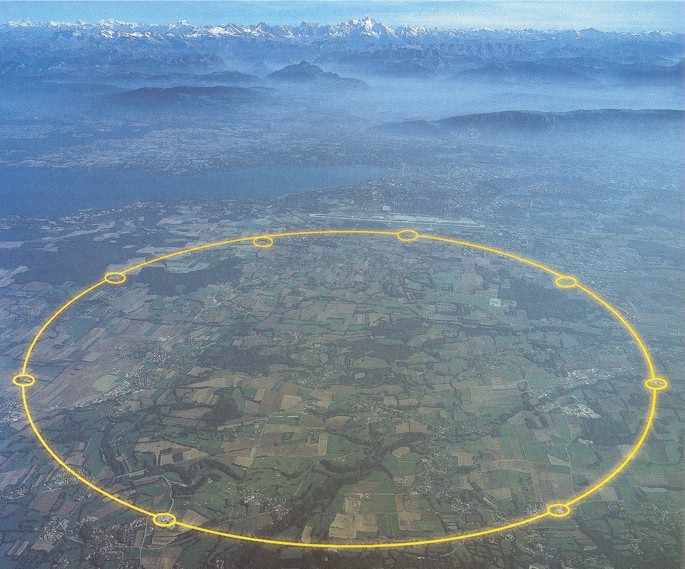
Why is the Large Hadron Collider a big ring?

One answer is that is uses the same tunnel as the Large Electron Positron collider, the previous CERN high energy experiment.  When LEP was shut down, the LHC made use of the facilities, rather than dig new ones.  However, this ultimately only kicks the question back a step to ask why LEP was built that way.  And neither machine is an oddity; the recently closed Tevatron also used a circular design, as did BaBar, CLEO, SppS and most high energy machines in at least my lifetime.

Friday, 30 March 2012

Measurements of Jet Substructure

One of the hot topics in the particle theory community at the moment is the use of jet substructure.  Jets are one of the most common types of objects we actually see in colliders: streams of roughly collinear particles.  They arise due to the fact that the strong nuclear force is, well, strong.  The fundamental particles that interact through this force---quarks and gluons---can not exist in isolation.  If you try and pull two quarks apart, for example, the energy in the interaction between them is so great it can spontaneously create more particles from the vacuum.  This means that when a particle collider like the LHC creates a quark or gluon in an interaction, that quark or gluon quickly acquires a number of followers which bind into (meta-)stable particles like pions, kaons, protons and neutrons.


These collections of particles are what show up in the actual detectors.  In older experiments, all we really cared about was the direction and energy of these things, which is roughly the same as the original quark or gluon.  You can do a lot of good physics just on that information alone.  But two things are different about the LHC.  First, the angular resolution of the experiments is much better, allowing us to truly resolve the individual particles within the jet.  Second, the large energy of the collisions leads to new types of events where heavy objects like Ws, Zs and tops can be produced with relativistic velocities.

Monday, 26 March 2012

Really Big Microscopes

One natural question for the non-scientist is why we need to build particle accelerators and colliders.  I don't mean why in the sense of what we hope to learn, and why it's important [1]; I mean why these are the best tools for the job.  After all, when most people want to look at something small, they use a magnifying glass or microscope.  What's wrong with just building a more powerful lens to study the smallest scales of nature?