I hate to link to XKCD for the second comic in a row, but the most recent one really struck a chord with me. While it is a little unfair, it hits what is to me the essential weakness of frequentist statistics: that the standard null-hypothesis rejection only considers how unlikely something is to happen by chance. In contrast, the Bayesian analysis weighs the different possibilities using prior information.
Also, the willingness of the Bayesian character in the strip to place a bet relates to the characterisation of probability as degrees of belief; intuitive, meaningful in a Bayesian approach, but impossible under a strict frequentist interpretation.

Saturday, 10 November 2012

Friday, 9 November 2012
What is Seen
So, a couple of days ago I discussed the problem of infinities in quantum field theories (QFTs). I noted that two types of infinities exist, infrared (where we get a 1/0 in our perturbation expansion) and ultraviolet (where an integral to infinity diverges). Today I'll discuss the resolution to the former, which is conceptually easier to grasp. What makes this question interesting is that the answer forces us to think about what we can actually hope to measure in an experiment.
Wednesday, 7 November 2012
No Surprises
So apparently there was an election today?
As so often, Randall Munroe of XKCD gets to the point:
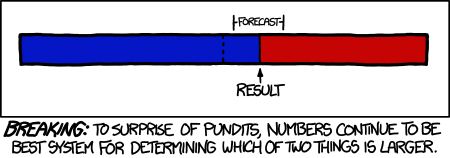 Props to Nate Silver, Sam Wang and especially Drew Linzer, who's been predicting this outcome since June. Scorn to the media pundits and conservative bloggers who attacked Nate Silver for the temerity to suggest Obama was ahead on the basis that the polls showed Obama was ahead. Relief for me, that my USAlien friends can live in a country that is still at least partly sane.
As so often, Randall Munroe of XKCD gets to the point:
Tuesday, 6 November 2012
Juggling Infinities
In the introduction to his textbook on quantum field theory, Steven Weinberg recounts a saying from his days as a (post-)graduate student:
Just because something is infinite does not mean it is zero!The infinities here show up in quantum field theory (QFT) when we look at the perturbation series beyond leading order. They confused people a lot during the development of QFT, but their resolution is physically interesting, and something I've been meaning to talk about for a while. Today, I'm only going to be able to set up the problem; I hope to get to the solution by the end of the week.
Monday, 5 November 2012
Taxes are Optional
Another day, another story of massive tax avoidance:
The key line comes later in the report, though:Apple paid less than 2% corporation tax on its profits outside the US, its filing with US regulators has shown.The company paid $713m (£445m) in the year to 29 September on foreign pre-tax profits of $36.8bn, a rate of 1.9%.
It has not been suggested that any of their tax avoidance schemes are illegal.It's okay, though. It's not as if countries around the world are in some sort of budget crisis, or anything.
Monday, 29 October 2012
Crawl
All right. Let's do this.
Way, way back in March, I talked about Roguelikes in general, and gave my opinion of one of the main examples of that genre of game, Angband. I followed this up with a review of probably the most famous example, NetHack, in April. I originally intended to these reviews a regular series, and planned to review another major variant, Crawl, a week or two later.
Well, only six months late.

Way, way back in March, I talked about Roguelikes in general, and gave my opinion of one of the main examples of that genre of game, Angband. I followed this up with a review of probably the most famous example, NetHack, in April. I originally intended to these reviews a regular series, and planned to review another major variant, Crawl, a week or two later.
Well, only six months late.

Thursday, 25 October 2012
Who the Hell is Mallory?
Via the BBC, worrying news for Android users like me:
What I found most confusing, though, was the title of the paper: "Why Eve and Mallory Love Android". Eve of course is the common name for the eavesdropper in cryptographical circles, but I've never heard of Mallory, hence my question above! Some wiki-ing gives the answer (the malicious attacker) and a long list of names that makes it clear I know much less about cryptography than I though...
Our analysis revealed that 1,074 (8.0%) of the apps examined contain SSL/TLS codeNow, I don't use my Android phone for anything sensitive. Further, the Android marketplace is open, so you'll have good and bad software there; in that sense there's no surprise that some of the apps have security flaws. I've only skimmed the relevant paper, but I didn't see any list of who these troublesome programs were from. The authors do observe that the insecure apps include mainstream ones, with tens of millions of installations, but at first glance this seems to be what you'd expect in an unmonitored market. In short, caveat emptor and be careful with your data.
that is potentially vulnerable to MITM [Man in the Middle] attacks. Various forms of SSL/TLS misuse were discovered during a further manual audit of 100 selected apps that allowed us to successfully launch MITM attacks against 41 apps and gather a large variety of sensitive data.
What I found most confusing, though, was the title of the paper: "Why Eve and Mallory Love Android". Eve of course is the common name for the eavesdropper in cryptographical circles, but I've never heard of Mallory, hence my question above! Some wiki-ing gives the answer (the malicious attacker) and a long list of names that makes it clear I know much less about cryptography than I though...
Subscribe to:
Posts (Atom)